
Academics
Grades 5–8
Middle School Academics
What students study in grades 5–8, and how we decide where each student starts.
Placement by readiness
Math, science, and world language courses at Kirby are placed by readiness and prior coursework rather than by grade level. A 6th grader who is ready for Algebra 1 takes Algebra 1; a 7th grader who needs another year of Mathematical Problem Solving before Pre-Algebra takes it without anyone treating that as falling behind. The same logic runs through science, where core courses are selected by math ability, and through language, where a student who starts Spanish or Latin in 7th grade can reach honors levels by graduation. Because of this, many middle school classes mix grade levels, and students who are ready to stretch further have room to.
Placement decisions are made by teachers who know the student, using prior coursework and teacher recommendation. New students are placed deliberately in their first weeks and adjusted if the initial placement turns out to be wrong in either direction.
Curriculum at a Glance, grades 5–8
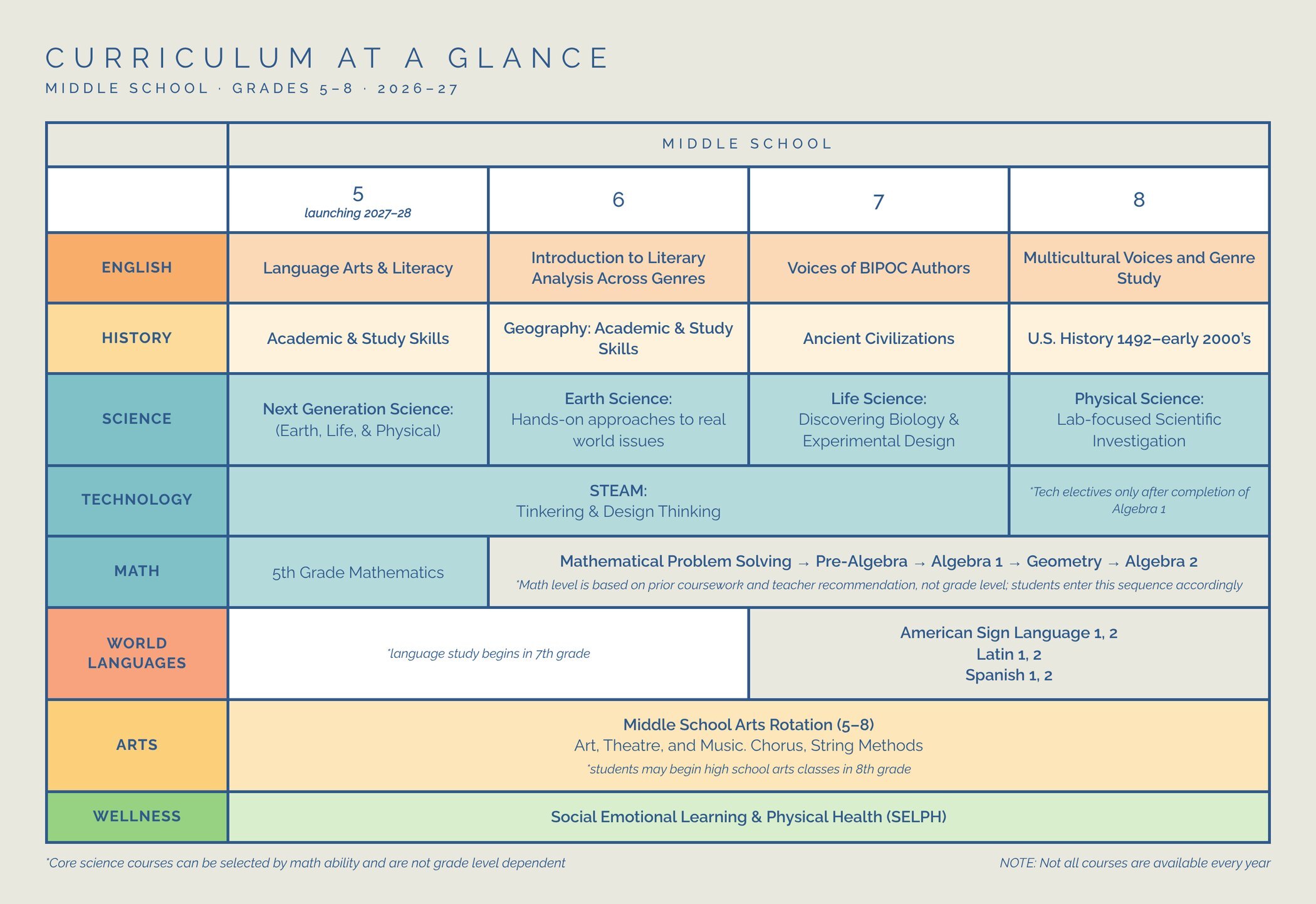
Not all courses are available every year. Math level is based on prior coursework and teacher recommendation, not grade level; students enter the sequence accordingly. Core science courses can be selected by math ability and are not grade-level dependent. Language study begins in 7th grade. Students may begin high school arts classes in 8th grade.
The subjects
English
Students read across genres and write in every mode, from literary analysis to personal narrative. The sequence runs from Language Arts and Literacy in 5th grade to Introduction to Literary Analysis Across Genres in 6th, Voices of BIPOC Authors in 7th, and Multicultural Voices and Genre Study in 8th. Discussion asks students to prepare and to be precise, and by 8th grade they are writing sustained essays and practicing the habits of inquiry they will carry into high school.
History
Fifth and sixth grade pair geography with academic and study skills, so students build the habits of organization, note-taking, and planning inside the content rather than as a separate class. Seventh grade is Ancient Civilizations and eighth is U.S. History from 1492 to the early 2000s. Students learn to interpret sources, construct arguments, and connect history to the present.
Science
Fifth grade covers Next Generation Science across earth, life, and physical science. The 6th through 8th grade sequence moves through Earth Science (hands-on approaches to real-world issues), Life Science (discovering biology and experimental design), and Physical Science (lab-focused scientific investigation). Students design investigations, test hypotheses, and present findings, and those who are ready can move into Biology before high school.
Mathematics
The sequence runs from 5th Grade Mathematics through Mathematical Problem Solving, Pre-Algebra, Algebra 1, Geometry, and Algebra 2, and students enter it wherever their readiness places them. The program is designed so that most students entering in middle school can complete Calculus before graduation. Technology electives, including STEAM: Tinkering and Design Thinking, open up after Algebra 1.
World languages
Language study begins in 7th grade with a choice of Spanish, Latin, or American Sign Language. Spanish emphasizes communication and fluency in listening, speaking, reading, and writing; Latin builds precision with grammar and vocabulary and opens classical texts and culture; ASL builds expressive and receptive signing. Middle schoolers can reach level 2 by 8th grade and continue into the high school sequence.
Arts
All middle schoolers rotate through art, theater, and music, with chorus and string methods available, and students may begin high school arts classes in 8th grade. The Arts section of the site has the full picture.
Wellness
SELPH, our social-emotional learning and physical health program, runs through middle school and builds self-awareness, resilience, and executive functioning skills alongside physical activity and teamwork. Students move into Health and Wellness and High School Fitness and Sports in 9th grade.
How we grade
Fifth and sixth grades use pass/fail grading with detailed written feedback, so that students in their first year learn to care about the work itself before grades enter the picture. Seventh and eighth grade transition to traditional letter grades, with the same emphasis on feedback and revision. Across all grades, assessment favors depth and demonstrated understanding over speed and recall.
Homework, with balance
At Kirby, we believe students learn best when they're both challenged and cared for. Our approach to homework reflects that belief: it's rigorous by design, but intentionally structured to protect balance, wellness, and joy in learning. Every aspect of our approach is grounded in research about how students best learn, including our partnership with Stanford's Challenge Success program. Deep understanding comes from focus and reflection, not just repetition.
Every student in grades 7 through 12 enrolls in at least one study hall period, providing two to three and a half hours each week of teacher-supervised quiet work time, which helps students manage workload, develop executive functioning skills, and sustain high-quality effort. At least once each semester the entire school takes a homework-free weekend. Our faculty collectively set department-specific limits for homework time by grade, informed by studies showing that beyond a certain point additional homework increases stress without improving learning, and those limits rise gradually so that students grow into a more demanding load as they move through the grades. Our daily schedule rotates course blocks so students take half of their classes each day, which spaces out homework and reduces transitions between subjects.
The result is students who work hard and also sleep, play, create, and socialize. We believe the measure of a rigorous education is how a student incorporates new ideas and develops creativity and problem-solving capacity, and never simply how much work they can carry.
Support built in
Tutorial periods and office hours give students dedicated time each week to meet with teachers, organize assignments, and get help before anything falls behind. Advisory anchors each student in a relationship with an adult who follows them across the year. Students with documented learning differences work with our School Counselor on an individualized accommodation plan. For the full picture of learning support at Kirby, including what we do and do not offer, see Who Thrives Here.
Kirby School is an independent and private, college-preparatory 5–12 school in Santa Cruz where curious students are known deeply, challenged wisely, and grow into themselves.

Accredited by the California Association of Independent Schools (CAIS) and the Western Association of Schools and Colleges (WASC). Member of the National Association of Independent Schools (NAIS). Kirby School does not discriminate against any person on the basis of race, color, sex, religion, sexual orientation, physical disability or national origin.