
Who Thrives Here
Most parents have asked themselves this question at some point: is my child thriving at school, or just getting by?
For some, the answer comes easily. Grades are solid, teachers are kind, school feels manageable. And yet even with "fine" there can be a quiet uncertainty underneath it all, a sense that something essential may be missing, even if nothing is technically wrong. For others, the answer is heavier. A child who is disengaged, anxious, withdrawn, or simply unhappy, for whom school has become something to endure rather than a place to grow.
We're often taught to measure school success through visible markers: grades, test scores, advancement, awards. Those things matter, but they don't tell the whole story. A child can be achieving, and still be shrinking. They can be meeting expectations, checking boxes, and moving smoothly through the system while quietly disconnecting from themselves, their curiosity, or their sense of belonging. Sometimes the more adept a child is at conforming to external expectations, the harder it becomes to notice when something essential isn't working.
True thriving lives at the intersection of challenge and care. It shows up when students are stretched intellectually without being hardened, supported emotionally without being coddled, and known as individuals rather than managed as outcomes. That is the environment Kirby is built to be, and it is what we mean when we say students here are challenged and cherished.

The students Kirby is for
Kirby is for bright, curious students who don't fit easily into boxes, and who wouldn't want to. They come to us from public schools, other independent schools, and homeschool, and they arrive for different reasons. Some are already flying and want room to go further than a standard classroom allows. Some have been doing fine on paper while quietly losing interest, and their parents can feel it. Some have started to armor up in a high-pressure environment, and their curiosity has narrowed along with their confidence. Some have never had a teacher who really understood them. What they have in common is a readiness to be challenged and a need to be known while it happens.
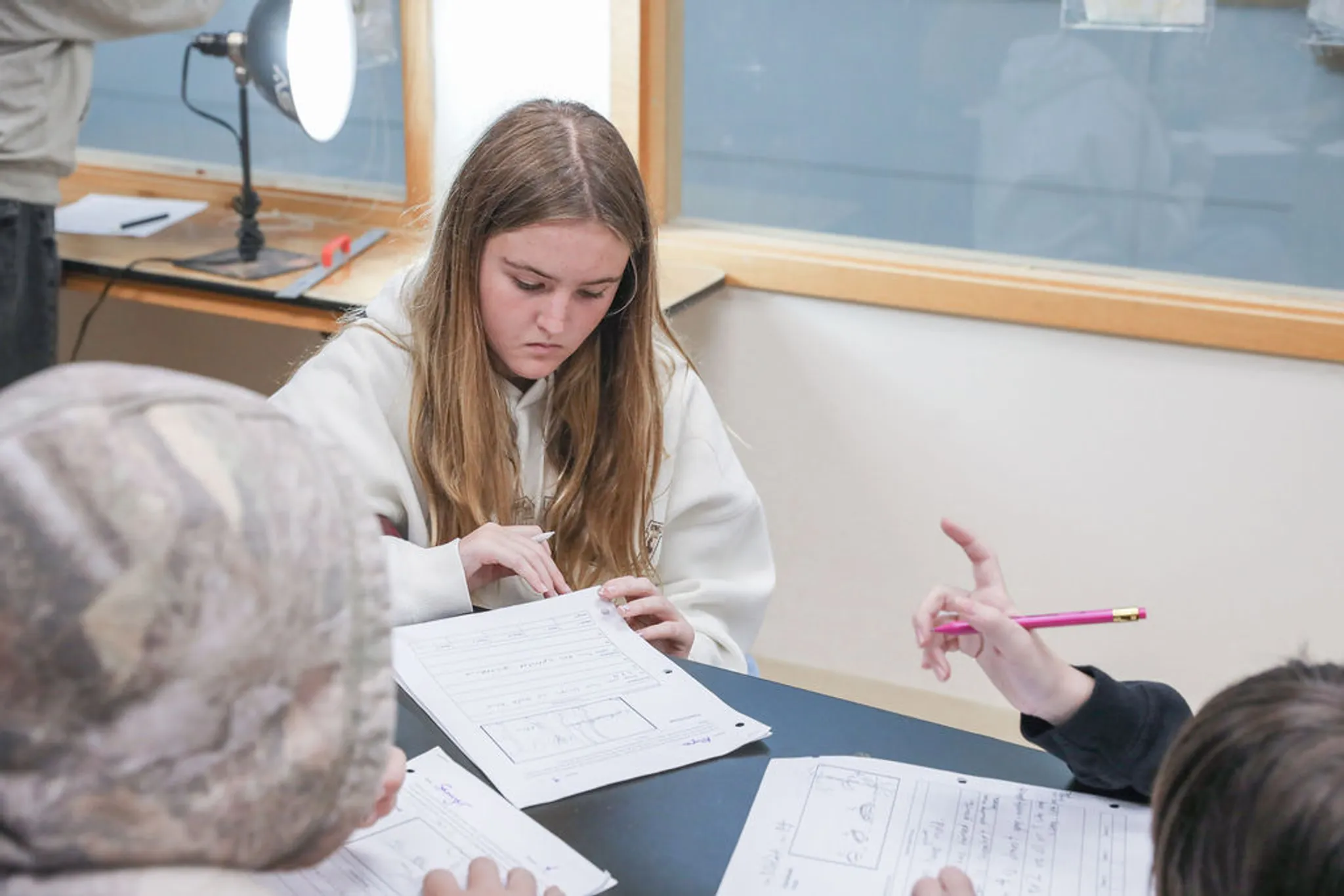
Students thrive here when they are interested in ideas and willing to engage with them out loud. Our classes are small and discussion-driven, and teachers will ask a student what they think and expect an answer. For most students that becomes the best part of school. For a student who would rather stay anonymous, it can be uncomfortable at first, and we say so during admissions.
They thrive when they can work independently with appropriate supports, manage transitions and unstructured time with increasing autonomy, sustain attention in class without frequent redirection, and be present consistently, both physically and relationally. The pace and structure of the day call for self-direction, personal responsibility, and respect for community norms. Students do not need to have all of this figured out when they arrive; the middle school in particular is built to grow it. They do need to be ready to practice it.
They thrive when they are open to being known. The adults here notice when something is off and ask about it. Students who have learned to keep their heads down elsewhere sometimes need a few months to trust that this is a good thing. When they do, they stop spending their energy on self-protection and start spending it on their work, their friendships, and their curiosity.
What thriving looks like
When students are truly thriving, it tends to show up across four interconnected dimensions, and each one is something Kirby is designed to produce on purpose.
Intellectual vitality
Thriving students are engaged thinkers. Learning may not always be comfortable, but it feels meaningful. You might notice curiosity that extends beyond assignments, a willingness to wrestle with ideas rather than just produce answers, and pride in thinking deeply even when it's hard. This kind of rigor isn't driven by fear or pressure. It's fueled by trust that effort matters more than performance, and that thinking is valued even when it's unfinished.
Emotional and psychological safety
No student can grow while constantly bracing themselves. Thriving students feel safe making mistakes, respected by adults and peers, and valued for who they are, not just how they perform. Emotional safety doesn't eliminate challenge. It makes real challenge possible, because students aren't spending their energy protecting themselves from embarrassment, dismissal, or shame.
Belonging and peer culture
Belonging isn't about fitting into a mold. It's about being accepted as you are and expected to grow. Thriving students feel comfortable being themselves, have peers who respect difference, and don't spend their days self-monitoring or self-protecting. When belonging is real, students can turn their energy outward toward learning, creativity, discovery, and connection, rather than inward toward survival.
Agency and growth
Thriving students aren't passive recipients of education. They try new things even when unsure, take intellectual or creative risks, and begin to develop voice, confidence, and ownership. Agency grows when students are trusted, when growth matters more than polish, and when adults model curiosity rather than control.
Download the guide
Parents often notice thriving in smaller, more human moments rather than report cards: how a child talks on the drive home, how they describe their day, how they respond to challenge. Thriving doesn't mean school is always easy, and struggle on its own doesn't mean something is wrong. Often it means school is doing what it should. But when struggle becomes chronic, or when curiosity, confidence, or connection steadily erode, it may be time to look more closely. Our guide for parents, Is Your Child Thriving at School or Just Getting By?, walks through the signs of a mismatch between a student and their environment, the questions worth asking your child and any school you are considering, and what to do if you're concerned.
Learning support at Kirby
Thriving does not mean the absence of anxiety, depression, learning differences, neurodivergence, or physical health challenges. Many children are navigating real and ongoing complexities, and they can still grow, learn, and develop a strong sense of self in the right environment. At the same time, schools are not a substitute for clinical care, therapeutic support, or medical treatment when those are needed. For some students, thriving depends on a both/and: a school environment that understands them, alongside appropriate external support. What matters most is whether the environment recognizes who a child is, responds with skill and care, and collaborates with the supports they need.
At Kirby, learning support is woven into the fabric of our academic and relational life rather than added on. Our schedule includes dedicated time each week for connection, coaching, and catch-up, so students stay on track without waiting until they fall behind. Every student in grades 7 through 12 takes at least one study hall period, which provides two to three and a half hours of teacher-supervised quiet work time each week. Tutorial periods and office hours give students time to meet with teachers, organize assignments, get help, and reflect. Advisory anchors each student in a relationship with an adult who follows them across the year. These supports aren't extras; they're part of how we teach, and part of how students learn to lead their own growth. Students with documented learning differences work with our School Counselor to create an individualized accommodation plan, and teachers receive practical, clear guidance designed to meet needs with care and discretion. Common accommodations include extended time on assessments, reduced-distraction or quiet testing environments, assistive tools such as audiobooks or text-to-speech, and organizational scaffolds or task-management strategies. Students remain in the classroom with their peers and engage fully with the college-preparatory curriculum. We do not offer remedial classes, pull-out instruction, or long-term therapeutic services, and we do not offer hybrid models, home instruction, or distance learning for extended absences. Our academic program is both rigorous and relational, and students are expected to meet its demands with appropriate support in place.
Finding out together
If you are trying to work out whether Kirby is the right match for your student, we would rather have that conversation early than late. A shadow day is the fastest honest read on fit for everyone, including us. If your student has documented learning differences or a history of needing significant support, we invite a conversation with our School Counselor before you apply, so that together we can clarify whether our model aligns with your student's needs and make sure they are positioned to thrive.
Kirby School is an independent and private, college-preparatory 5–12 school in Santa Cruz where curious students are known deeply, challenged wisely, and grow into themselves.

Accredited by the California Association of Independent Schools (CAIS) and the Western Association of Schools and Colleges (WASC). Member of the National Association of Independent Schools (NAIS). Kirby School does not discriminate against any person on the basis of race, color, sex, religion, sexual orientation, physical disability or national origin.