
Becoming a Senior

By Christy Hutton, Head of School
I've spent time with this year's senior class since sixth grade, both as a Head of School and a parent. In many ways this was the group of students who reassured us that students were not as harmed by COVID as the news stories led us to believe. They were immediately recognized as the students who “said yes” and modeled kind, courageous vulnerability in trying new things. While they don’t represent a large percentage of the student body, they are achieving at a high level in every opportunity we make available. They carried and revived the choral program through the pandemic, they're in every sport and every show, and this hasn’t taken them off the path of high academic achievement. If anything, their teachers notice the opposite: a genuine enthusiasm for the work that has always seemed to be about wanting to learn rather than about the pursuit of good grades.
There is a longer arc underneath all of this, and it begins in middle school. Those years are a time of experimentation, and the environment decides whether the experiments succeed or fail. In some settings it isn't safe to be a kind, empathetic young person, so students stop investing in those traits, and the cycle of self-protection feeds itself. Plenty of adults look back on high school and assume that's all it could ever be. But when you put authentic, supportive guardrails in place early, and when older students model what achievement with kindness and grace actually looks like, the full range of options stays open.
Students who arrive at Kirby in middle school know they're trusted, and they want to live up to it. Students coming from environments with heavier rules and harsher discipline sometimes take longer to believe the adults are here to help build their futures rather than to catch their mistakes. By the end of ninth grade, though, it's unmistakable, and it shows in how they treat the community's trust–as something worth protecting.
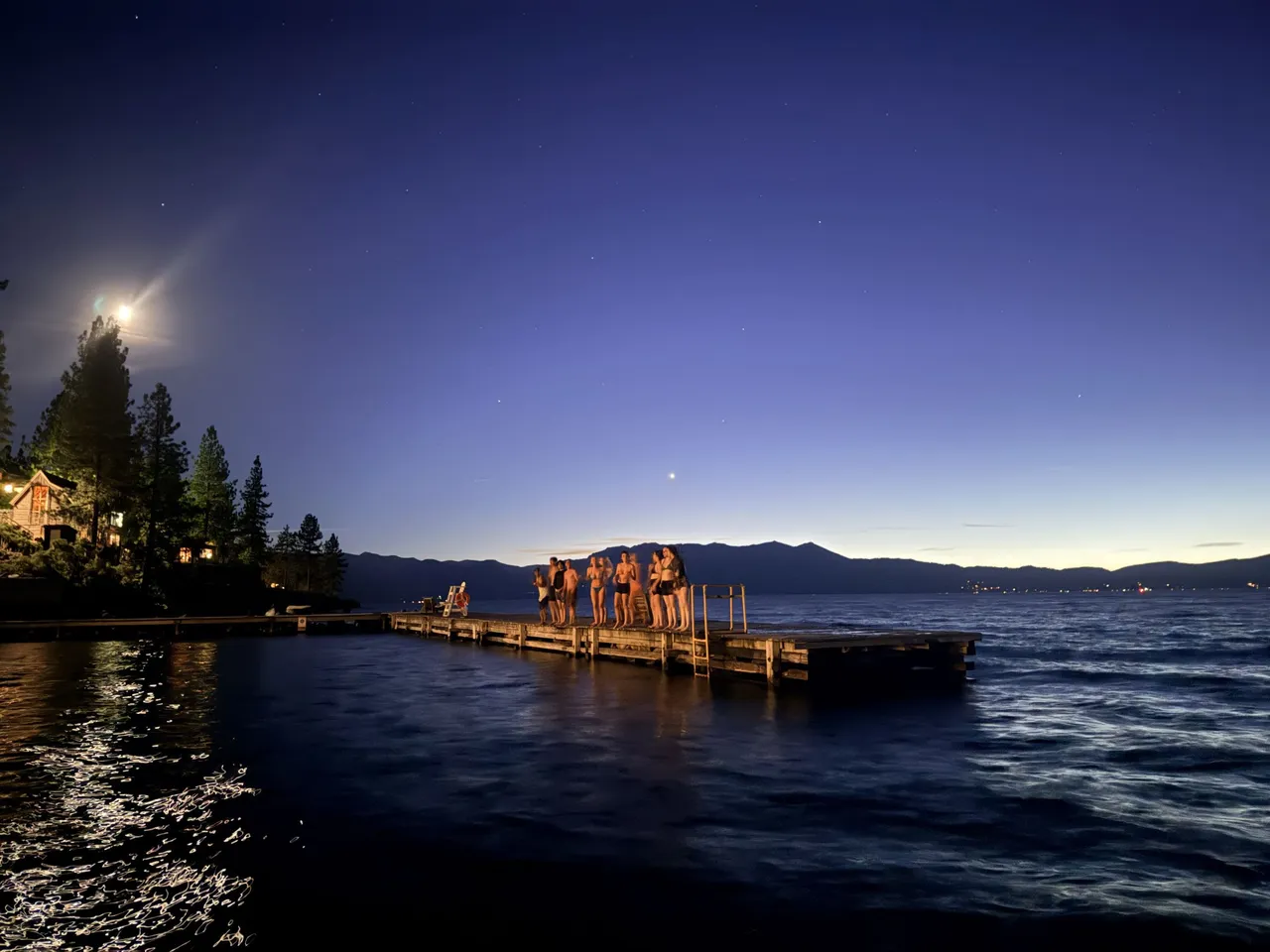
We believe in our students from the day they arrive and we trust their good intentions. What changes over six years is what that trust can hold. We wouldn't ask sixth graders to plan and run their own retreat, and we don't need to, because the structure around them is built for where they are. By senior year, the structure can mostly step back. I was lucky enough to chaperone this year's senior retreat, which the class co-created with Katie Trigg, Spanish Teacher and Senior Traditions and Retreat Coordinator. They chose a rustic cabin in Tahoe with shared rooms, shared bathrooms, and an industrial kitchen. Every dinner, and most desserts, they planned, shopped for, cooked, and cleaned up themselves. They took pride in their menus and divided the labor so efficiently that the kitchen was always left spotless. There was lake or river time every day, but the ritual they created for themselves was the night swim, all of them running down to the water's edge before bed, every night.
Their care for one another left the chaperones with almost nothing to enforce. Our job was safety: sunblock, water, a head count. That is not how most adults treat teenagers, and it is not how most schools run a program like this one. It is what a light hand on the reins makes possible when the trust underneath it has never been in question.
On the final night we gathered by the fire. I reminded them of what they had been to each other: a class that has been one another's cheering section through every ordinary and extraordinary thing adolescence throws at you. This is a group that can read what another person needs before it's said. I told them the truth–that it is rare to build, later in life, a group of people who will know you and care for you this well, and that they should savor the time they have left together. The tears came as they realized it was true.
Our seniors set the tone for the whole school. It starts with them: how they show up at Griffin Gathering, how they carry themselves at games, how they lead. The rest of the school takes its cue from what they model. Watching this class step into that role–and inhabit it as the kind, inclusive, gentle, ambitious people they are while investing in each other–is the best evidence to me for what holding this practice of trust over time creates in our students.
Kirby School is an independent and private, college-preparatory 5–12 school in Santa Cruz where curious students are known deeply, challenged wisely, and grow into themselves.

Accredited by the California Association of Independent Schools (CAIS) and the Western Association of Schools and Colleges (WASC). Member of the National Association of Independent Schools (NAIS). Kirby School does not discriminate against any person on the basis of race, color, sex, religion, sexual orientation, physical disability or national origin.