
Academics
Grades 9–12
High School Academics
What students study in grades 9–12, how we place them, and what advanced work looks like here.
Placement by readiness
Math, science, and world language courses at Kirby are placed by readiness and prior coursework rather than by grade level. A 9th grader who has completed Algebra 2 and is ready for physics takes physics; a senior can reach Honors Multivariable Calculus, Honors Linear Algebra, or Honors Differential Equations. Core science courses can be selected by math ability and are not grade-level dependent, so one student might begin with Chemistry or Physics while another starts with Biology before advancing. Because of this, many high school classes mix grade levels, and students who are ready to stretch further have room to.
Placement decisions are made by teachers who know the student, using prior coursework and teacher recommendation. New students, whether they arrive in 9th grade or later, are placed deliberately in their first weeks and adjusted if the initial placement turns out to be wrong in either direction.
Curriculum at a Glance, grades 9–12
| 9 | 10 | 11 | 12 | To graduate | |
|---|---|---|---|---|---|
| English | Identity and Change | Self & Society: Gender, Race, and Class | Honors Multicultural U.S. Literature, Banned Books, Creative Writing, Fear Itself: Horror & the Human Experience, Personal Narratives, Queer Voices in Literature, Utopias, Dystopias, Honors History, Literature & Art of Indigenous U.S. | 4 years | |
| History | World History: Ancient and Medieval | Modern World History (or Honors) | United States History. Honors U.S. History Practicum, Honors Comparative Government, Honors U.S. Government, Honors Psychology, Honors History, Literature & Art: African American Voices | 3 years | |
| Science | Biology → Chemistry → Physics. Honors Advanced Biology, Honors Advanced Chemistry, Honors Environmental Science, Human Biology, Marine Biology, Honors Advanced Physics. Core science courses can be selected by math ability and are not grade level dependent. | 3 years of lab sciences | |||
| Technology | Honors Computer Science Principles, Data & Computer Science, Engineering & Design Thinking, Robotics, Yearbook. Tech electives only after completion of Algebra 1. | ||||
| Math | Mathematical Problem Solving → Pre-Algebra → Algebra 1 → Geometry → Algebra 2. Honors Precalculus, Honors Calculus, Honors Multivariable Calculus, Honors Linear Algebra, Honors Differential Equations, Number Theory, Honors Statistics, Financial Mathematics. Math level is based on prior coursework and teacher recommendation, not grade level; students enter this sequence accordingly. | 3 years | |||
| World languages | American Sign Language 1, 2, 3, 4. Latin 1, 2, 3, Honors Latin Literature, Beyond the Canon, Honors Vergil’s Aeneid, Ancient Greek. Spanish 1, 2, 3, Honors Latin American Film and Culture, Honors Conversation & Literature. | 2 years of one language | |||
| Arts | Art: Foundation 2D and 3D Media (Art 1), Intermediate 2D and 3D Media (Art 2), Portfolio Preparation (Art 3), Honors Studio Art. Book Arts 1, 2, 3. Digital Photography, Dark Room Photography. 3-D Art: Ceramic Sculpture. Honors Art History. Theater: Intro to Drama, Advanced Drama, Theater Production. Music: Music Appreciation, Music Theory, Honors Music Theory, Chamber Choir, Jazz Choir, Jazz Band, String Methods, Orchestra, Digital Music Production and Recording, Instrument Studies (percussion, piano, guitar). | 2 years of electives | |||
| Wellness | Health & Wellness | High School Fitness/Sports | High School Fitness/Sports | High School Fitness/Sports | 4 units of fitness |
Special programs: Academic Language Support, Student Council/Government Cabinet, and Teaching Assistantship(s) may be taken as an 8th class. Not all courses are available every year.
Advanced courses at Kirby
We offer advanced work across math, science, and humanities, carrying an honors designation that comes with a weighted grade point and signals the highest rigor available in our curriculum to colleges. We've deliberately stepped away from the AP course designation to better align our offerings with our true approach to intellectual depth and challenge. We don't believe an externally standardized test is the highest expression of intellectual seriousness, nor do our courses align with a "teach to the test" approach. Students who wish to sit for AP exams can still do so, and our honors courses go deeper than the AP curricula.
Honors courses offered
Not all courses are available every year.
- Honors Multicultural U.S. Literature
- Honors History, Literature and Art of Indigenous U.S.
- Honors Modern World History
- Honors U.S. History Practicum
- Honors Comparative Government
- Honors U.S. Government
- Honors Psychology
- Honors History, Literature and Art: African American Voices
- Honors Advanced Biology
- Honors Advanced Chemistry
- Honors Environmental Science
- Honors Advanced Physics
- Honors Computer Science Principles
- Honors Precalculus
- Honors Calculus
- Honors Multivariable Calculus
- Honors Linear Algebra
- Honors Differential Equations
- Honors Statistics
- Honors Latin Literature
- Honors Vergil's Aeneid
- Honors Latin American Film and Culture
- Honors Conversation and Literature (Spanish)
- Honors Studio Art
- Honors Art History
- Honors Music Theory
Intensive Paths
Our Intensive Paths program provides structured opportunities for students to pursue advanced, college-level work in STEM, Humanities, Languages, and the Arts. Each path combines honors and advanced coursework, independent research or creative projects, and close faculty mentorship, exceeding our standard, already-challenging graduation requirements. Across every path, students share a common experience: the freedom to shape their education.
An Intensive Path is a choice a student makes, usually by the end of 9th or 10th grade, with a faculty mentor who helps them plan a course of study around a focus. Completion is noted on the transcript. Students who choose not to pursue a path follow the General Path, which already exceeds the University of California entry requirements.
Science and Technology Intensive Path (STIP)
- Four years of lab science (16 units): Biology, Chemistry, Physics, and one advanced elective.
- Four years of math (16 units), including at least Precalculus.
- Eight additional elective units in science, math, or computer programming.
- An independent research project or internship (2 or 4 units, 60 to 120 hours).
- Attendance at STIP speaker seminars and events.
- Mentorship from a faculty mentor or the Academic Dean.
Core science courses are taken at Kirby; off-campus science work, such as at Cabrillo College or UC Santa Cruz, requires Academic Dean approval for credit.
Humanities Intensive Path (HIP)
- Four years of history (16 units) and four years of English (16 units).
- Six elective units in English or history.
- A Senior Project (2 units).
A humanities mentor helps the student plan an interdisciplinary course of study built around a focus that leads to the senior project.
Languages Intensive Path (LIP)
- All general graduation requirements, with electives devoted to focused language study.
- Twenty-four units in languages, including at least one language through Level 4.
The goal is advanced language skill and a deeper understanding of other cultures.
Arts Intensive Path (AIP)
- Meets UC admission requirements and the 98-unit minimum graduation requirement, plus 18 additional elective units in the arts, supervised by a faculty advisor.
- A creative culminating project, completed and presented in senior year (2 units).
Students may take a general arts program or concentrate in one discipline.
The subjects
English
Four years of English ground students in critical reading, expository and persuasive writing, and literary analysis. The sequence runs from Identity and Change in 9th grade to Self and Society: Gender, Race, and Class in 10th, then into electives and honors seminars in 11th and 12th, including Honors Multicultural U.S. Literature, Banned Books, Creative Writing, Fear Itself: Horror and the Human Experience, Personal Narratives, Queer Voices in Literature, Utopias and Dystopias, and Honors History, Literature and Art of Indigenous U.S. Courses emphasize deep engagement with primary sources, sustained essays, and discussion that demands preparation and precision.
History
Three years of history: World History, Ancient and Medieval in 9th grade, Modern World History (or Honors) in 10th, United States History in 11th, and electives including Honors U.S. History Practicum, Honors Comparative Government, Honors U.S. Government, Honors Psychology, and Honors History, Literature and Art: African American Voices. Students work with primary sources, construct arguments, and practice what our faculty call pro-pro argument, taking on two seemingly opposing positions to build flexible, evidence-based thinking.
Science
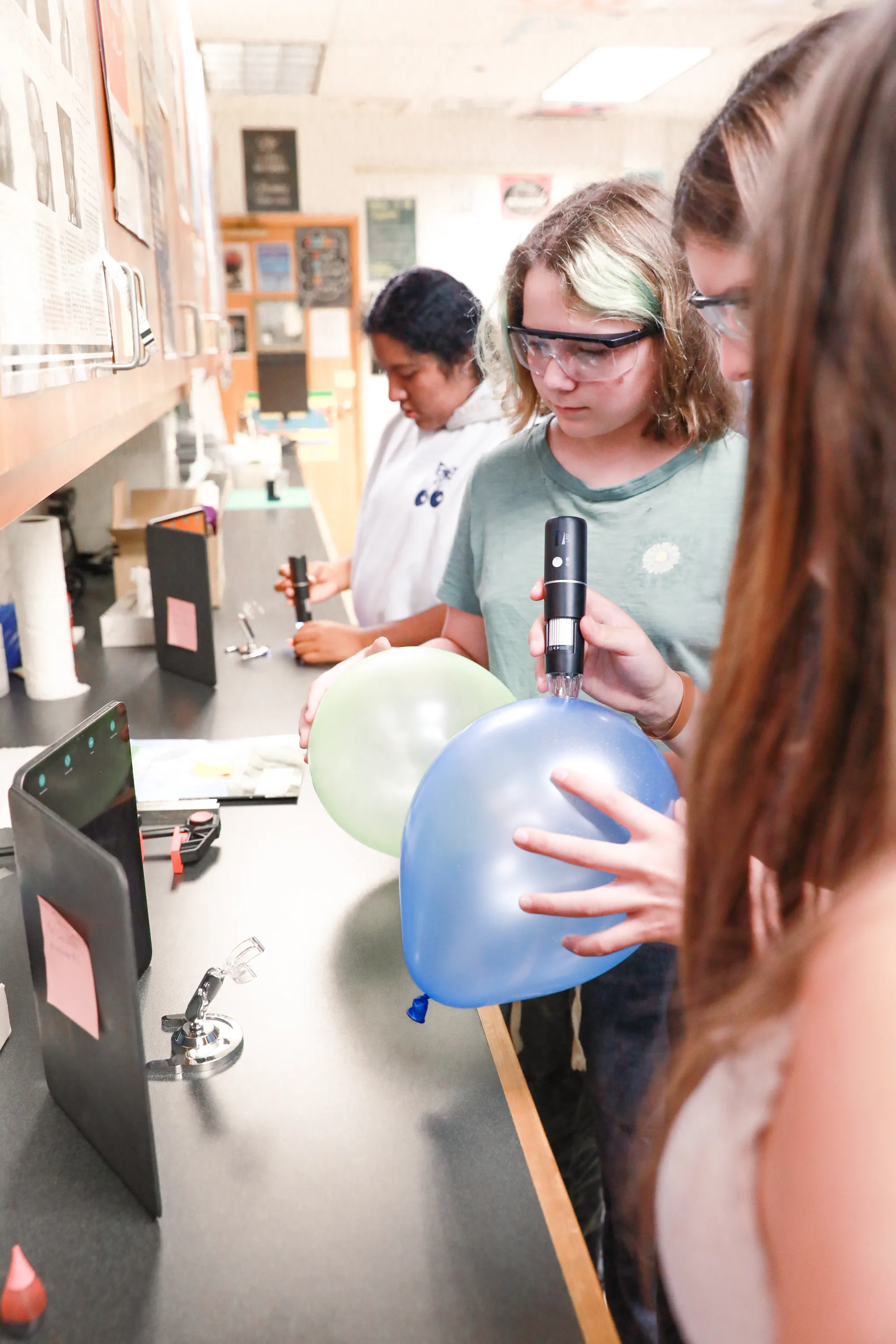
Three years of lab science, chosen by math readiness rather than grade: Biology, Chemistry, and Physics, with Honors Advanced Biology, Honors Advanced Chemistry, Honors Environmental Science, Honors Advanced Physics, Human Biology, and Marine Biology beyond the core. Across all courses students pose questions, design investigations, and present results.
Mathematics
Three years of math, entered wherever readiness places the student. The sequence runs from Algebra 1 through Geometry, Algebra 2, Honors Precalculus, and Honors Calculus to Honors Multivariable Calculus, Honors Linear Algebra, and Honors Differential Equations, with Number Theory, Honors Statistics, and Financial Mathematics as electives. Students can move well beyond the typical high school sequence.
Technology
Honors Computer Science Principles, Data and Computer Science, Engineering and Design Thinking, Robotics, and Yearbook, available after completion of Algebra 1.
World languages
Two years of one language are required and most students go further. American Sign Language 1 through 4; Latin 1, 2, 3, Honors Latin Literature, Beyond the Canon, Honors Vergil's Aeneid, and Ancient Greek; Spanish 1 through 3, Honors Latin American Film and Culture, and Honors Conversation and Literature. Students who began a language in 7th grade often reach honors and college-level proficiency by graduation.
Arts
Two years of arts electives are required. Visual art runs from Art 1 through Art 3 Portfolio Preparation and Honors Studio Art, with Book Arts 1 through 3, Digital Photography, Darkroom Photography, Ceramic Sculpture, and Honors Art History. Theater includes Intro to Drama, Advanced Drama, and Theater Production. Music includes Music Appreciation, Music Theory and Honors Music Theory, Chamber Choir, Jazz Choir, Jazz Band, String Methods, Orchestra, Digital Music Production and Recording, and Instrument Studies in percussion, piano, and guitar. See the Arts section for the full program.
Wellness
Health and Wellness in 9th grade, then High School Fitness and Sports; four units of fitness are required.
What it takes to graduate
Four years of English, three years of history, three years of lab science, three years of math, two years of one world language, two years of arts electives, four units of fitness, and a minimum of 98 units. These requirements exceed the University of California entry requirements. Special programs including Academic Language Support, Student Council and Government Cabinet, and Teaching Assistantships may be taken as an eighth class.
Homework, with balance
At Kirby, we believe students learn best when they're both challenged and cared for. Our approach to homework reflects that belief: it's rigorous by design, but intentionally structured to protect balance, wellness, and joy in learning. Every aspect of our approach is grounded in research about how students best learn, including our partnership with Stanford's Challenge Success program. Deep understanding comes from focus and reflection, not just repetition.
Every student in grades 7 through 12 enrolls in at least one study hall period, providing two to three and a half hours each week of teacher-supervised quiet work time, and upperclassmen often choose more. At least once each semester the entire school takes a homework-free weekend. Our faculty collectively set department-specific limits for homework time by grade, informed by studies showing that beyond a certain point additional homework increases stress without improving learning, and those limits rise gradually so that students grow into a more demanding load as they move through the grades. Our daily schedule rotates course blocks so students take half of their classes each day, which spaces out homework and reduces transitions between subjects.
The result is students who work hard and also sleep, play, create, and socialize. We believe the measure of a rigorous education is how a student incorporates new ideas and develops creativity and problem-solving capacity, and never simply how much work they can carry.
Support built in
Tutorial periods and office hours give students dedicated time each week to meet with teachers, organize assignments, and get help before anything falls behind. Advisory anchors each student in a relationship with an adult who follows them across the year. Students with documented learning differences work with our School Counselor on an individualized accommodation plan. For the full picture of learning support at Kirby, see Who Thrives Here.
Kirby School is an independent and private, college-preparatory 5–12 school in Santa Cruz where curious students are known deeply, challenged wisely, and grow into themselves.

Accredited by the California Association of Independent Schools (CAIS) and the Western Association of Schools and Colleges (WASC). Member of the National Association of Independent Schools (NAIS). Kirby School does not discriminate against any person on the basis of race, color, sex, religion, sexual orientation, physical disability or national origin.